Training programme based on Social Innovation
The Solidarity University adheres to several of the social innovation theory’s core principles. This means, amongst other things, that all our projects and processes contain an element of learning. We help others in their specific projects by explaining to them how the theory works, but simultaneously we continuously learn ourselves by analysing the projects we work on. Learning is a permanent given. We provide education on several levels. We can explain SI’s basic principles, but we also work on more in-depth courses in which people learn how they can give shape to and lead SI processes themselves.
Positive Healthy Innovation
One of the projects in which we participate together with GGD Zeeland, is ‘Positief Gezond Innoveren’ (Positive Healthy Innovation). Within this project, we work on the process of learning to transform from care to health in accordance with SI’s principles. This is a big cultural shift. In six living labs (interdomanial collaborations) we instigate group learning processes with SI in order to be able to make this move.
Changes
A process like that brings about many changes for all parties involved. A process approach is vital if you want to achieve progress in complex healthcare issues. It is a different way of working than what most healthcare professionals learned during their education. The cultural shift entails (amongs others) a move:
from legal frameworks to an issue-related work approach
from generalised thinking and acting to a more specific approach
from own self-interest to joint interests
from dealing with symptoms to an integral approach
Two trajectories
That change takes some work. Minimum requirements are: a different perspective, different skills and a different attitude, which is why process leaders are needed. The SI training programme contributes to an increase in more regional expertise in this field.
Withing the training programme there are two trajectories:
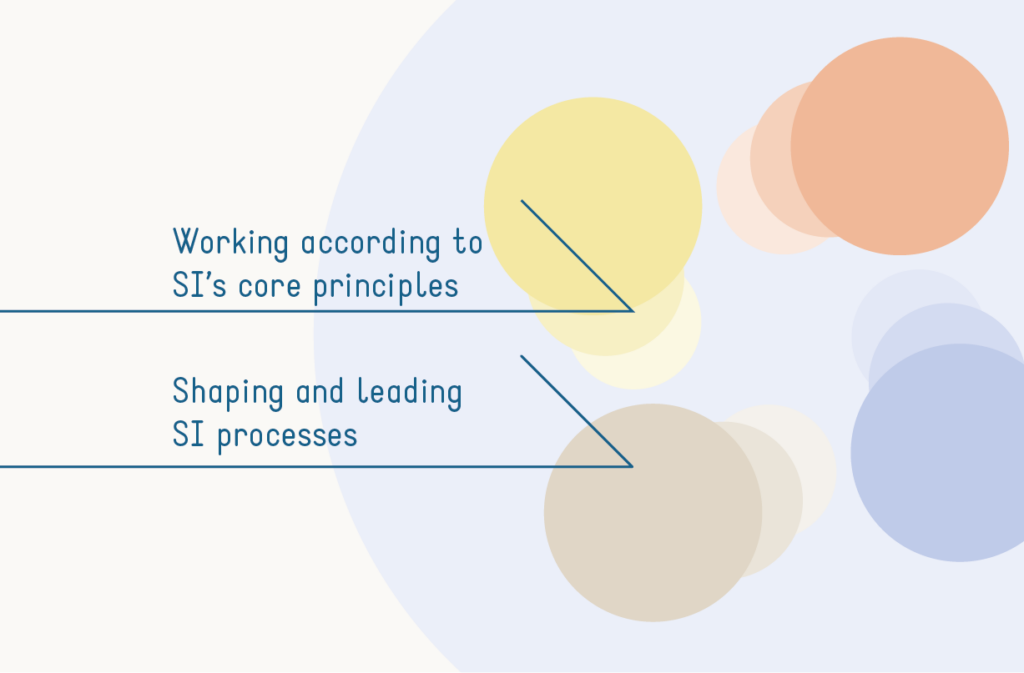
1. Working according to SI’s core principles
An eight-month trajectory. The programme’s participants are introduced to SI’s essential and core principles and learn how to apply them in practice. The programme comprises eight workshops (four on theory; four on application in practice). Participants bring their own cases or projects to the workshop and work on them.
2. Shaping and leading SI processes
A trajectory that takes a year. This more intensive trajectory has additional room for the development of skills needed to shape or lead SI processes as a process leader or ‘Facilitator of Change’. A trained Facilitator of Change can connect, reflect in a critical way and think conceptually.
Learning on the job
Both trajectories involve learning on the job. Trajectory 1 is available for municipal civil servants, healthcare professionals and project managers that, in practice, already work from a broad healthcare approach in interdisciplinary collaborations. At the moment we work with a select group of researchers and advisors from provincial healthcare service GGD Zeeland.
Where we are at right now
The training started in October 2025. An important goal for GGD Zeeland’s Public Health Advisors is to get it clear how they can fill in their advisory role in a different and more sustainable way. One of the biggest challenges in public healthcare is to approach healthcare challenges in a more integral way. The SI approach helps them to give shape to all this in close collaboration with the municipalities.